Who Really Votes for Conservation?
“Too Long, Didn’t Read” Speed Summary ASGA reviewed nine years of Atlantic States Marine Fisheries

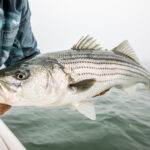
Imagery Courtesy of Sean Cobelli Media
We encourage anglers, guides and conservationists to use this public comment as a resource when participating in the upcoming public comment period for striped bass management. The Draft Addendum III to Amendment 7 of the Atlantic Striped Bass Fishery Management Plan (FMP) is now live. Public hearings are scheduled for the next few weeks. Striped bass are the backbone of saltwater recreational angling from Maine to Virginia. This document breaks down the issues, explains the science, and highlights how you can get involved and influence management. Your voice matters! Attend public hearings, submit comments, and rally others to ensure striped bass populations are around for future generations.
The goal of Amendment 7 (initiated in 2022) is to rebuild the spawning stock biomass (SSB) to its target level by 2029. Challenges in rebuilding are exacerbated by 6 years of recruitment failure, as well as managers ignoring the solid 2018 year class entering the slot. ASMFC delays, always taking the “bare minimum” action and missed opportunities have brought us to this point. Even if we rebuild by 2029, the 6 years of bad recruitment offer a bleak future after that deadline.
We are deeply disappointed that many jurisdictions decided against hybrid hearings for this comment period. It is difficult to attend hearings at 6 PM due to family obligations, work, and traffic. If the board wanted public input (as many bad actors “called for” to delay positive discussion), mandatory in-person attendance instead of utilizing the digital age is NOT how to do it. There will be a single “general hybrid hearing” at the end of the month. That being said, in-person participation is always most impactful. We are incredibly grateful for all the advocates willing to sacrifice income, time and energy to participate!
TOP LINE ISSUES WITH MANAGEMENT
We want to emphasize that if we continue to experience recruitment failure, there will be no other option to conserve this fishery but a moratorium.
Proposed Management Options in Addendum III
The addendum aims to reduce removals by 12% coastwide for a 50% rebuilding probability by 2029.
3.1 Method to Measure Total Length: Uniform definition to prevent slot expansion.
OUR RECOMMENDATION: 3.1: Measuring Striped Bass Option B – Mandatory uniform total length for consistency and to close loopholes.
3.2 Commercial Tagging: Point of Tagging: Reduce black market risks.
OUR RECOMMENDATION: 3.2: Commercial Tagging Option B – Tagging at harvest to curb illegal sales; B preferred for stricter control.
3.3 Maryland Chesapeake Bay Recreational Season Baseline: Simplify seasons, shift closures for better compliance/enforcement.
OUR RECOMMENDATION: 3.3: Chesapeake Bay Option C – New baseline with 10% buffer; suggest increasing to 15% for precaution (propose at hearings). We have more news on this to be released in the upcoming weeks.
3.4 Reduction in Fishery Removals
OUR RECOMMENDATION: 3.4: Option B-01 for Ocean – 12% equal reductions; oppose any commercial favoritism. For ocean: Sub-option O1 (uniform, no for-hire exemption); no-harvest closures (enforceable, allows C&R). Rhode Island should be included in the Northern region. Frankly, CT and NY share the water with Rhode Island and Massachusetts. If it is possible, you should push for NY and CT to be included in the Northern Region as well. Wave 4 is optimal for the North and Wave 6 is optimal for the Southern no harvest closures only.
Additional Concerns to Raise:
Public Hearings Schedule
Hearings run September 8-30, 2025, in affected states (ME-VA). Formats vary (in-person/hybrid/virtual). Maine (9/10), RI (9/16), NY (9/17), PRFC/DC (9/25), General Webinar (9/29). All the rest are in person only. Link to full list. Tips for Impact: Be factual, reference the stock assessment, and emphasize that abundance drives opportunity and the economy!
NH Public Hearing on Atlantic Striped Bass Draft Addendum III
Monday, Sep. 8, 2025 – 6:00 pm
ME Public Hearing on Atlantic Striped Bass Draft Addendum III
Tuesday, Sep. 9, 2025 – 6:00 pm
VA Public Hearing on Atlantic Striped Bass Draft Addendum III
Tuesday, Sep. 9, 2025 – 6:00 pm
ME Public Hearing Webinar on Atlantic Striped Bass Draft Addendum III
Wednesday, Sep. 10, 2025 – 6:00 pm
CT Public Hearing on Atlantic Striped Bass Draft Addendum III
Monday, Sep. 15, 2025 – 6:00 pm
RI Public Hearing on Atlantic Striped Bass Draft Addendum III
Tuesday, Sep. 16, 2025 – 6:00 pm
NJ Public Hearing on Atlantic Striped Bass Draft Addendum III
Tuesday, Sep. 16, 2025 – 6:00 pm
NY Hybrid Public Hearing on Atlantic Striped Bass Draft Addendum III
Wednesday, Sep. 17, 2025 – 6:00 pm
DE Public Hearing on Atlantic Striped Bass Draft Addendum III
Thursday, Sep. 18, 2025 – 6:00 pm
NY Public Hearing on Atlantic Striped Bass Draft Addendum III
Monday, Sep. 22, 2025 – 6:00 pm
MD Public Hearing on Atlantic Striped Bass Draft Addendum III
Tuesday, Sep. 23, 2025 – 5:30 pm
PA Public Hearing on Atlantic Striped Bass Draft Addendum III
Wednesday, Sep. 24, 2025 – 7:00 pm
PRFC & DC Public Hearing Webinar on Atlantic Striped Bass Draft Addendum III
Thursday, Sep. 25, 2025 – 6:00 pm
MA Public Hearing on Atlantic Striped Bass Draft Addendum III -Woburn
Thursday, Sep. 25, 2025 – 6:00 pm
General Public Hearing Webinar on Atlantic Striped Bass Draft Addendum III
Monday, Sep. 29, 2025 – 6:00 pm
MA Public Hearing on Atlantic Striped Bass Draft Addendum III
Tuesday, Sep. 30, 2025 – 6:00 pm

“Too Long, Didn’t Read” Speed Summary ASGA reviewed nine years of Atlantic States Marine Fisheries
“Too Long, Didn’t Read”: NOAA’s sweeping revision of recreational fishing data has dramatically changed the
American Saltwater Guides Association Calls on ASMFC to Follow its Own Math and Implement a

“Too Long, Didn’t Read”: There was an Executive Order on saltwater fishing last week. Executive
We rely on our members and donations to keep fighting for a sustainable tomorrow in marine conservation.

The Morning Blitz Cap. 100% of proceeds fund The Striper Project. Only 100 made. Don't miss out!
Shop The CapGIVE THE GIFT OF FISHERIES CONSERVATION THIS HOLIDAY SEASON. SHOP ASGA GOODS THAT FUND FISHERIES RESEARCH & ADVOCACY CAMPAIGNS
JOIN ASGA IN CALLING FOR CRITICAL MANAGEMENT ACTION AFTER YEARS OF SPAWN FAILURES & POOR MANAGEMENT.
By using this website, you agree to our use of cookies. We use cookies to provide you with a great experience and to help our website run effectively. To learn more, please review our privacy policy.
10 Responses
We seem to be no further ahead than 3 years ago and yet we actually think it can happen by 2029 ? Kidding, right ? The entire “50% chance of success” model seems like a prescription to fail. Always has.
I favor complete moratorium,both commercial and recreational. One only need to look at the Atlantic salmon situation in eastern Canada to know what happens due to over-fishing and improper management. If you want the fish to be there, you’ve got to leave them there
If we can optain reasonably good data, the rules should change automatically every year based on stock size.
We should have to think about changing rules as often as curently done.
As far a rules for this year, I would vote for the most stringent reductions possible short of a complete moratorium for both the commericial and recreational sides.
The key is enforcement. Without an effective way to do this ……… nothing works.
correction. We should NOT have to think about changing rules as often as curently done.
If closing the season is the answer then close it for all. Nothing we do will help if you close for recreationally fishing, and let the commercial guy kill the population.
Have a continuous annual six month March-August moratorium in ALL waters and when open have the size and limit the same for ALL categories.
The last fish (Striped Bass) I kept was caught on 10/14/19, since then every striper I caught has been released and were properly handled and most swam away. Instructions on how to measure a bass properly is really needed The length should be determined by using a tape measure laid along side the fish not over the fish remember it’s a bass not a tuna. It is like measuring a protractor, 6 inches along the bottom but 9 inches over the top. I’ve seen stripers that were 45 inches long weighed in a tackle shop and told that it was 47 1/2 inches long. When I stated the actual length I was told IGFA allows over the top, which is true if it’s a tuna.
I saw a huge slaughter of striped bass in the Essex River estuary this June. A large school of big fish came into the Essex mid June. I live in Ipswich and was flyfishing one evening. There were 3 other boats. Saw some surface action and came back the next two nights. I caught a 20lb and two close to 40lbs on flyrod and by the 3rd day there were 10 boats fishing live eels and mackerel. My son said commercial season just opened and they had two days to take an astounding 15 big fish per day. Went back a couple of days later and the commercial guys were still there and my son says the quota is not met. At this pint there were 50 boats within about 3/4 of a mile of each other. Fish were being caught non stop. What a horrible policy giving the commercial guys a couple of weeks to kill this large school. I wouldn’t be surprised if there weren’t 500 fish killed. These guys know how to fish( live bait) and with sonar can easily find the fish. There is no way there was any supervision. I’m sure guys fished overnight split up their catch or sold straight to restaurants. THIS POLICY IS THE PROBLEM!!
What if we go all catch and release for now no trouble hooks only circle hooks on live bait. what are the problems seems to be the handling of the fish. I wish we could educate.. So many of the boats that I see catch the fish let it flop around in the deck then they throw it out like it. It’s a bag of trash. .
It’s very hard to enforce, but we need to educate.
Simply put these are valuable fish alive. Stop all harvest commercial and recreational.