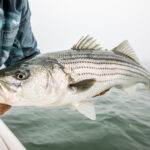
Who Really Votes for Conservation?
“Too Long, Didn’t Read” Speed Summary ASGA reviewed nine years of Atlantic States Marine Fisheries

ASMFC Summer Meeting – August 4–6, 2026
The Atlantic States Marine Fisheries Commission meets in Arlington August 4-6 for its Summer Meeting. Several boards will convene, but a handful of agenda items will shape management decisions for years. Here is a detailed breakdown of what matters most for fisheries conservation advocates:
Atlantic Menhaden Management Board
Wednesday, August 5 | 1:45 – 5:30 p.m.
This is the most important session of the entire meeting.
The Board will consider approving Draft Addendum II for public comment. The addendum focuses on the Chesapeake Bay Reduction Fishery Cap and contains two critical decision points:
One of the options under consideration (Section 3.1.2, Option B) would create an automatic proportional adjustment. If the coastwide TAC increases in the future, the Bay Cap would rise with it. If the TAC decreases, the Bay Cap would fall.
The Chesapeake Bay is not a scaled-down version of the ocean. It is a distinct ecological system with its own patterns of localized depletion, its own forage demands from predators, and a long record of concentrated industrial harvest. Tying the Bay Cap to the ocean quota removes the Board’s ability to manage the Bay independently and on its own scientific merits. It treats a critical nursery and feeding area as just another line on a spreadsheet.
We also need to be clear-eyed about last year’s action. The Board approved a 20% reduction in the coastwide TAC. On paper, it looked like meaningful progress. In reality, the menhaden fishery landed roughly 77% of the previous quota. A 20% cut applied to a quota that was already under-utilized produced little to no actual reduction in harvest. In some scenarios, it effectively allowed the same or even slightly higher landings. That outcome was compounded by problems in the stock assessment, including natural mortality values that understated fishing pressure for years. We have been removing too many menhaden for too long. Another paper reduction is not enough.
This public comment period on Draft Addendum II is the best opportunity in years to demand a real cut in Bay harvest and to keep the Bay Cap independent of the ocean quota. Once the document is approved for public comment, the range of options that go out to the public largely defines the final decision space. Weak reduction options or an automatic-adjustment mechanism will be much harder to fix later.
The Board will also review a Committee on Economics and Social Sciences report on economic impacts to the bait fishery from TAC changes and provide guidance to the Technical Committee on 2027–2029 specifications. Those items are relevant, but the structure and independence of the Bay Cap itself is the core fight.
The bottom line is that ASMFC set the Total Allowable Catch far too high. You can see from these two charts that when the TAC increased substantially in 2016-2018 and again in 2023, the bait fisheries in the Chesapeake and likely the overall menhaden availability plunged. Once the draft document is approved, we will provide our advocates a breakdown of the options so we can all do our part to turn this mess around.


Atlantic Striped Bass Management Board
Thursday, August 6 | 8:30 – 9:30 a.m.
The Striped Bass Board has a shorter agenda but several items worth attention.
The primary action item is consideration of formal comments to NOAA Fisheries on its technical memorandum Charting a Course for Striped Bass: Science and Regulatory Innovation for Offshore Aquaculture. NOAA has been exploring the possibility of striped bass aquaculture in federal waters. The Commission is preparing a response that reflects Board member concerns about environmental impacts, genetic interactions with wild stocks, disease transmission, enforcement challenges, and the broader policy implications of allowing aquaculture of a recovering wild stock in the EEZ. The draft letter will be refined and advanced to the ISFMP Policy Board.
The Board will also review and consider approval of the 2026 Fishery Management Plan Review and state compliance reports for the 2025 fishing year. There are no de minimis requests this cycle. An update will be provided on the 2027 benchmark stock assessment; the assessment workshop is scheduled for late August in Arlington, with peer review expected in mid-2027 so the revised MRIP time series can be fully incorporated. Finally, the Board will review and populate Advisory Panel membership, including a nomination for a North Carolina seat.
No major new management measures are expected at this meeting. The stock continues to face consecutive years of poor recruitment, so any discussion of future direction or aquaculture policy carries weight.
Atlantic Herring Management Board
Tuesday, August 4 | 10:00 – 11:00 a.m.
The Herring Board will consider acceptance of the 2025 Research Track Stock Assessment and the 2026 Management Track Stock Assessment, along with their respective peer review reports, for management use. Presentations will cover assessment results and peer review findings.
While herring may appear secondary on a multi-species agenda, its status has direct relevance to menhaden discussions. Atlantic herring is a major forage species. Persistent weakness in the herring stock strengthens the scientific and policy case for more precautionary management of other forage species, including menhaden, particularly inside the Chesapeake Bay where localized depletion and predator needs are already documented concerns. The Board will also receive an update from the New England Fishery Management Council on recent actions separating herring specifications from river herring and shad measures.
ISFMP Policy Board
Thursday, August 6 | 9:45 – 11:45 a.m.
The Policy Board covers several cross-cutting issues.
Sector Separation remains one of the more concerning items. Staff will present the current timeline and the process for a stakeholder workshop planned for September. The workshop is intended to inform development of management objectives and options for the Sector Separation Amendment being developed jointly with the Mid-Atlantic Fishery Management Council. Sector separation continues to raise significant concerns. It risks creating complicated, inequitable allocation systems that add administrative burden without delivering clear conservation benefits for most recreational fisheries. Any acceleration of the timeline or narrowing of options should be scrutinized closely.
Other agenda items include:
Committee on Economics and Social Sciences
August 4 (1:00–4:00 p.m.) and August 5 (8:30 a.m.–4:00 p.m.)
CESS will provide an update on the Striped Bass Recreation Demand Model, review progress on species-specific tasks (menhaden bait fishery impacts, spiny dogfish, and tautog), discuss data access issues, and cover broader topics including risk-and-uncertainty frameworks, an AI tool presentation, and human mobility data applications. The menhaden economic work feeds directly into the Wednesday Board discussion and is worth noting even for those who cannot follow the full committee sessions.
The Bottom Line:
The Menhaden Board on Wednesday afternoon is the clear priority. The two outcomes that matter most are a meaningful, real-world reduction in the Chesapeake Bay Cap and the rejection of any automatic linkage between the Bay Cap and the coastwide ocean quota. The Bay requires its own strong, independent limit based on the best available information about localized conditions and forage needs. This public comment period is the moment to insist on both.
Striped bass requires attention on the aquaculture response and the long-term recruitment problem. Herring provides important context for forage management philosophy. Sector separation on the Policy Board should be approached with continued skepticism.
The meeting is hybrid. Materials and webinar links are posted on the ASMFC website. Public comment is typically taken at the beginning of each board meeting, though chairs often limit comment on items already scheduled for formal public hearings.
Stay focused on the Bay Cap. The decisions made this week will shape menhaden management for years.
“Too Long, Didn’t Read” Speed Summary ASGA reviewed nine years of Atlantic States Marine Fisheries
“Too Long, Didn’t Read”: NOAA’s sweeping revision of recreational fishing data has dramatically changed the
American Saltwater Guides Association Calls on ASMFC to Follow its Own Math and Implement a

“Too Long, Didn’t Read”: There was an Executive Order on saltwater fishing last week. Executive
We rely on our members and donations to keep fighting for a sustainable tomorrow in marine conservation.

The Morning Blitz Cap. 100% of proceeds fund The Striper Project. Only 100 made. Don't miss out!
Shop The CapGIVE THE GIFT OF FISHERIES CONSERVATION THIS HOLIDAY SEASON. SHOP ASGA GOODS THAT FUND FISHERIES RESEARCH & ADVOCACY CAMPAIGNS
JOIN ASGA IN CALLING FOR CRITICAL MANAGEMENT ACTION AFTER YEARS OF SPAWN FAILURES & POOR MANAGEMENT.
By using this website, you agree to our use of cookies. We use cookies to provide you with a great experience and to help our website run effectively. To learn more, please review our privacy policy.
4 Responses
Could you tell me where online or on lactation this meeting is?
Thanks
Here is the info for online attendance. The second part of your request, well…. we are going to leave that one alone! https://asmfc.org/events/2026-summer-meeting/
These fish are a critical link in the chain, please don’t be so short sighted as to bow to those capitalizing on a public resource at the expense of future generations. When the forage fish are fighting for survival, so are the species that rely on them. It is simply wrong to continue to allow such flagrant overfishing and abuse of the resource.
You often leave a direct way t obriefly share our postiion and often concise suggests from you. Are any of these forthcoing?