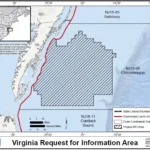
Opposition to BOEM’s Proposed Seabed Mining Off Virginia’s Coast
The federal government is once again testing how far it can push industrial extraction into

The November ASMFC Menhaden Board meeting will be one for the ages, yet many advocates and anglers aren’t talking about it (or simply are unaware it’s happening). One corrected error in the menhaden stock assessment is now driving three separate fights at the same time. If we don’t keep them straight, we risk winning one and losing the others, to the detriment of the resource.
Here’s the shortest summary:
If you’re still reading, you’re our kind of people. Lock the doors and strap in for a more detailed rundown below.
The Coastwide Problem: Natural Mortality and the TAC
The 2025 single-species stock assessment update revised the estimate of natural mortality (M) — the rate at which menhaden die from causes other than fishing. Previous assessments used an M value of 1.17 based on a 2019 paper that re-analyzed 1960s tagging data. During the 2025 ERP benchmark process, scientists found an error in how magnet efficiency was calculated in that original paper. After correcting it, the Stock Assessment Subcommittee settled on a revised base estimate of M = 0.92.
That single change had massive consequences.
When the model assumes high natural mortality, it must conclude the population is very large to produce the observed catches and survey indices. When natural mortality is lowered, the model concludes the population does not need to be as large. The result: the time-series average age-1+ biomass came out roughly 37% lower than in the 2022 update, and fishing mortality estimates rose.
That lower biomass was fed into the ecological reference point models. The previous TAC of 233,550 mt is now projected to have a 100% probability of exceeding the new ERP fishing mortality target. Achieving a reasonable chance of staying at or below the target would have required roughly a 50% cut.
Last fall the Board only approved a one-year TAC for 2026 (186,840 mt — a 20% reduction) and explicitly deferred the multi-year decision to the November 2026 Annual Meeting. Because the fishery has only been landing about 77–80% of the quota in recent years, a 20% cut is largely a paper reduction. Menhaden are not paper fish.
This is the single most important fight on the table.
The Chesapeake Problem & “The Bay Cap”
Draft Addendum II focuses on the Chesapeake Bay Reduction Fishery Cap — the limit on how much of the coastwide quota can be taken from inside the Bay.
Key options under consideration:
One critical point that keeps getting confused: The Bay Cap is not extra quota. It is a sub-limit inside the coastwide TAC. At the current 51,000 mt against a 186,840 mt TAC, the Bay Cap represents about 27% of the total allowable catch. Cutting the Bay Cap is important for localized depletion concerns in the Chesapeake, but it does not solve the larger coastwide problem created by the assessment error.
The Reallocation Problem
There is growing pressure, particularly from New England, to shift quota from states that do not fully use their allocation to states that will. Maine’s menhaden landings have risen sharply as Atlantic herring have collapsed. The lobster industry needs large volumes of bait, and Maine now has the infrastructure to take significantly more menhaden. This is a real economic pressure. It is also a conservation risk.
Moving unused quota to states that will catch every pound increases actual removals even if the paper TAC stays the same. In a fishery that is already over the corrected science, unused quota is currently one of the only things keeping realized harvest below the limit on the page. Reallocation without a meaningful TAC reduction is the wrong direction. Changing state allocations requires a full addendum process under Amendment 3. It cannot be done casually at the November meeting.
What We Should Be Fighting For
We can get a meaningful reduction on both the coastwide TAC and the Bay Cap. That should be the goal. Conflating the three issues — or letting reallocation become the main event — risks walking away with a paper win that does not actually put more menhaden in the water. The assessment error is black-and-white. The science supports a substantial cut. That is where the focus needs to stay.
Bay Cap (Draft Addendum II)
This has a formal public comment process. Hearings will occur in September and October. Final action is scheduled for the November Annual Meeting. Submit formal comments.
2027–2029 Coastwide TAC
This is a separate agenda item with no formal public comment period. The only way to influence it is to email your state’s commissioners on the Menhaden Management Board directly. Our formal position blog will include contact information and suggested language.
We can come together and force the reductions the corrected assessment requires — both coastwide and in the Bay. That is the real win. That is what ASGA will be pushing. Stay tuned for our formal position piece with specific preferred options and comment instructions
The federal government is once again testing how far it can push industrial extraction into
The North Carolina Marine Fisheries Commission has opened the public comment period on a proposed
Feature Photo: Captain Ben Whalley and his clients release a beautiful bass at water level.
One number has quietly shaped striped bass management for nearly 30 years: 9% release mortality.
We rely on our members and donations to keep fighting for a sustainable tomorrow in marine conservation.
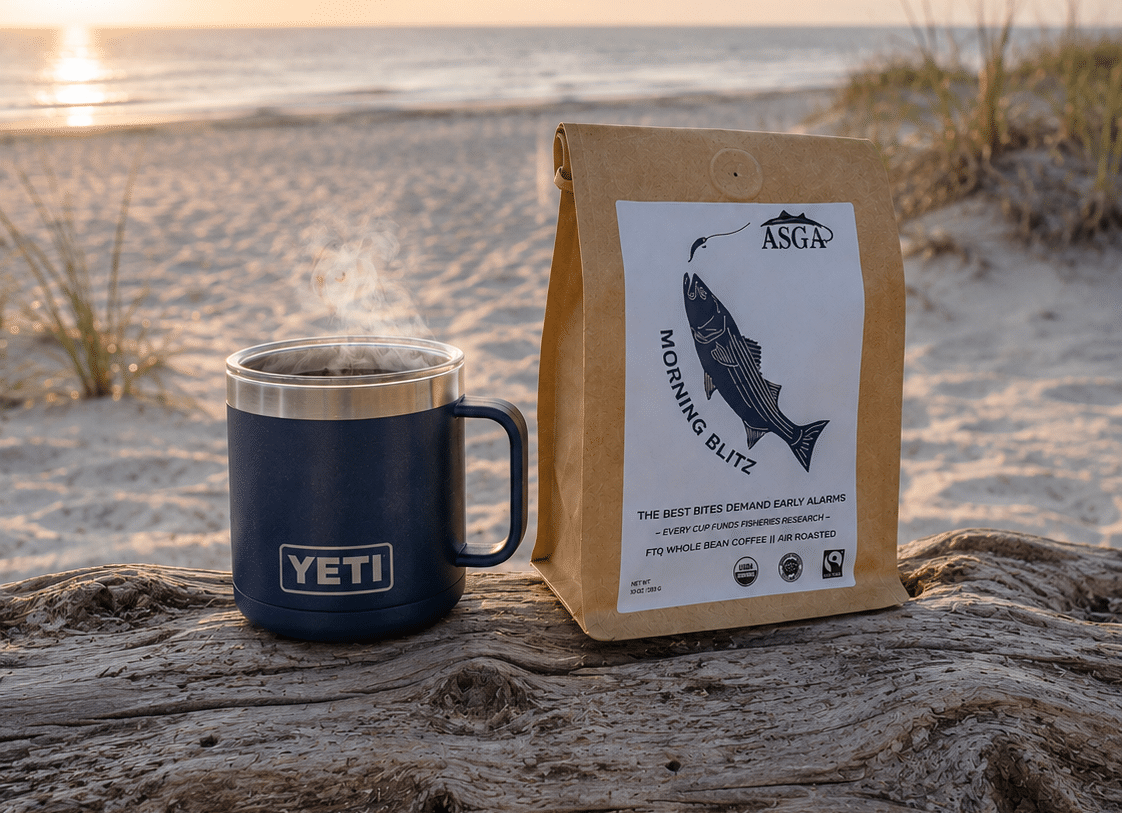
A premium coffee crafted for the ASGA community. Every bag funds striped bass research.
Shop Morning BlitzGIVE THE GIFT OF FISHERIES CONSERVATION THIS HOLIDAY SEASON. SHOP ASGA GOODS THAT FUND FISHERIES RESEARCH & ADVOCACY CAMPAIGNS
JOIN ASGA IN CALLING FOR CRITICAL MANAGEMENT ACTION AFTER YEARS OF SPAWN FAILURES & POOR MANAGEMENT.
By using this website, you agree to our use of cookies. We use cookies to provide you with a great experience and to help our website run effectively. To learn more, please review our privacy policy.